
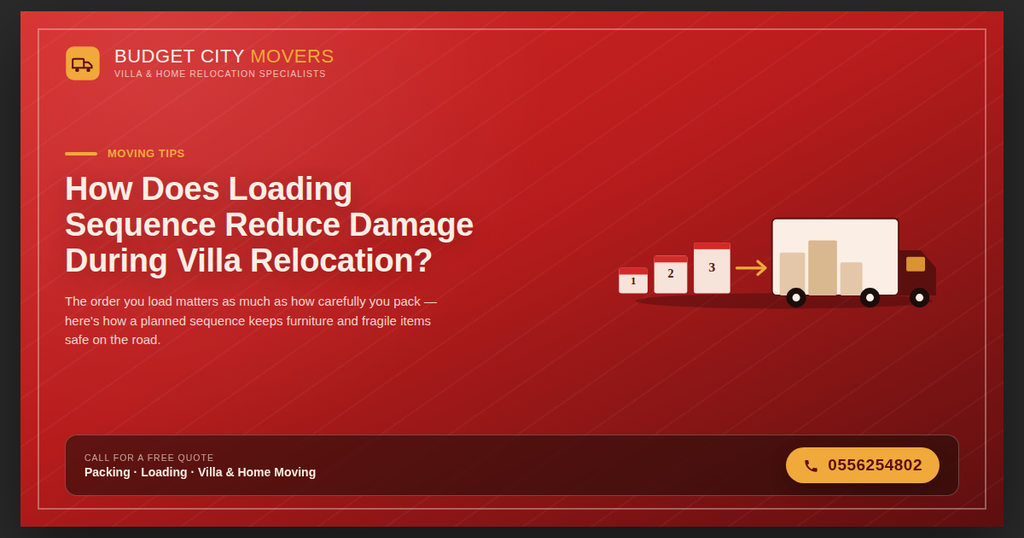
Moving a villa requires careful planning because household belongings vary in size, weight, fragility and handling requirements. The order in which these items enter the moving truck can affect how securely they travel and how easily they can be unloaded at the destination.
A proper loading sequence reduces damage during villa relocation by positioning heavy furniture securely, separating fragile belongings, balancing the load and preventing items from shifting during transportation. It also helps movers avoid unnecessary rearranging, which can expose furniture and appliances to additional handling risks.
For homeowners in Dubai, understanding how loading sequence works can help them prepare for a more organized relocation, protect valuable belongings and make informed decisions when arranging professional moving services.
What Is a Loading Sequence During Villa Relocation?
A loading sequence is the planned order for placing furniture, appliances, cartons and other household belongings inside a moving vehicle.
Rather than loading items randomly, the moving team considers their weight, dimensions, packaging, stability and unloading requirements before deciding where each item should go.
For example, a large wardrobe needs secure positioning and sufficient support, while a carton containing glassware requires protection from pressure and movement. Loading both items without considering their differences could increase the risk of damage.
A practical loading plan considers:
- Furniture dimensions and structural stability.
- Weight distribution throughout the cargo area.
- Protection required for delicate household items.
- Safe positioning of appliances and bulky belongings.
- Available truck capacity and securement points.
- The order in which items will be removed at the destination.
The purpose is to create a stable, organized load that remains secure throughout the journey.
How Does Loading Sequence Reduce Damage During Villa Relocation?
Loading sequence helps reduce damage by controlling the way household belongings are positioned, supported and secured. Each stage serves a different purpose, from establishing a stable base to protecting delicate items.
1. It Creates a Stable Base for Heavy Furniture
Large furniture pieces, including wardrobes, bed frames, cabinets and solid tables, require careful handling because of their weight and size.
When appropriate for the vehicle layout, these items are positioned early in the loading process. Their placement should support stability without creating excessive pressure on other belongings.
Furniture should be secured using suitable restraints and protective materials. Heavy objects must not be left free to slide or lean against weaker items.
The correct position depends on the furniture’s shape, center of gravity and structural strength, rather than weight alone.
2. It Keeps Fragile Items Away From Excessive Pressure
Glass furniture, mirrors, ceramics, decorative accessories and delicate electronics can be vulnerable to impact or crushing.
A planned loading sequence helps keep these belongings away from heavy furniture and prevents them from being used as support for other items.
For example, a glass tabletop should receive suitable protective packaging and secure positioning instead of being placed beneath heavy cartons.
This approach reduces direct contact, pressure and the chance of fragile items being damaged when the vehicle moves.
3. It Helps Maintain Balanced Weight Distribution
A moving truck needs a properly distributed load to support safe transportation.
If too much weight is concentrated in one area, the arrangement may become unstable. Poor positioning can also increase movement when the vehicle brakes, turns or travels over uneven surfaces.
Movers should distribute the load appropriately while following the vehicle’s weight limits and axle requirements.
Balanced positioning helps create a more stable transport arrangement and reduces unnecessary stress on individual belongings.
4. It Reduces Movement Inside the Moving Truck
Even well-packed belongings can be damaged if they slide, tip or collide during transportation.
A suitable loading sequence allows movers to secure items as the cargo area fills, rather than leaving everything to be stabilized at the end.
Appropriate straps, protective blankets and suitable packing materials can help prevent shifting. Empty spaces should be managed carefully so that belongings remain secure without placing excessive pressure on fragile surfaces.
What Is the Correct Order for Loading Villa Belongings?
There is no universal loading order for every villa move. The sequence depends on the truck, furniture dimensions, cargo weight, handling requirements and unloading plan.
However, the following example illustrates how movers can organize different categories of belongings.
| Loading stage | Items and purpose |
| Initial loading | Suitable large furniture positioned to establish a stable arrangement |
| Main loading | Bulky household items and appliances placed according to their handling requirements |
| Carton placement | Suitable boxes arranged according to weight, strength and stability |
| Final positioning | Protected fragile belongings placed in secure, appropriate spaces |
| Final inspection | Load checked for movement, imbalance and unsecured items |
This sequence is a general example rather than a fixed rule. Some appliances, delicate furniture or unusually shaped objects may need to be loaded earlier because of their dimensions or specific handling instructions.
How Should Heavy Furniture Be Loaded to Prevent Damage?
Heavy furniture needs more than physical strength to move safely. Its preparation, positioning and securement all affect how well it travels.
Prepare Furniture Before Moving It
Where appropriate, detachable legs, shelves and other removable components should be taken off and packed separately.
Drawers and doors should be secured according to the furniture’s construction. Loose components can move during handling and cause scratches or impact damage.
Protective blankets or suitable coverings can help protect wooden finishes, upholstery and polished surfaces.
Position Furniture According to Its Structure
Furniture should be placed on appropriate support surfaces and secured in a position that minimizes movement.
Large wardrobes and cabinets may require specific handling because of their height and center of gravity. They should not be positioned in a way that allows them to tip or place pressure on weaker furniture.
Glass components and delicate decorative sections require separate protection.
Avoid Excessive Stacking
Not every furniture item can safely support another object.
Placing heavy cartons on an unsuitable table, cabinet or upholstered sofa can cause pressure damage, deformation or scratches.
Movers should assess whether an item can support additional weight before stacking anything on top of it.
How Can Fragile Belongings Be Protected During Loading?
Fragile belongings need individual protection because their vulnerability depends on both the material and the way they are packed.
A carton containing ceramic dishes requires a different approach from a television, framed artwork or glass cabinet.
Homeowners and movers can reduce risks by following these precautions:
- Wrap delicate items individually using suitable protective materials.
- Use sturdy cartons that can support the packed contents.
- Fill appropriate gaps to reduce internal movement.
- Keep heavy objects away from fragile cartons.
- Label delicate packages clearly for careful handling.
- Secure mirrors, artwork and glass components using suitable supports.
Electronics should be packed according to their sensitivity and manufacturer recommendations. Screens, connectors and delicate components should not be exposed to excessive pressure.
Important: Fragile labels help communicate handling requirements, but they do not replace proper packaging, positioning or securement.
Why Does Truck Space Planning Matter for Villa Relocation?
Villa moves often involve belongings from several rooms, including bedrooms, living areas, kitchens, storage spaces and outdoor areas.
Without a loading plan, movers may discover that bulky furniture does not fit the remaining space or that certain items need to be rearranged.
This can increase handling and create opportunities for accidental contact or damage.
Truck space planning helps identify:
- Which furniture items may require disassembly.
- Whether large appliances need special positioning.
- How much cargo space the belongings are likely to occupy.
- Which items need individual protection.
- How belongings should be arranged for unloading.
- Whether the selected vehicle is suitable for the load.
A room-by-room inventory or pre-move survey can help estimate the volume of belongings and identify unusual handling requirements before moving day.
This preparation is particularly useful when a villa contains large furniture, delicate decorative pieces or numerous appliances.
What Loading Mistakes Can Increase the Risk of Damage?
Some common loading mistakes can undermine otherwise careful packing.
| Mistake | Potential risk |
| Placing heavy items on weak cartons | Crushing or breakage |
| Leaving furniture unsecured | Sliding, tipping or impact |
| Uneven weight distribution | Reduced load stability |
| Using unsuitable restraints | Movement or pressure damage |
| Packing fragile items without sufficient cushioning | Internal collisions |
| Ignoring unloading requirements | Additional handling and rearranging |
Another common mistake is prioritizing speed over preparation. Loading belongings quickly without checking their position and stability can create avoidable problems later in the journey.
A systematic loading process should include checks during loading, not only after the truck is full.
How Can Dubai Homeowners Prepare for a Safer Villa Move?
Preparation before moving day can help homeowners and moving teams coordinate loading more effectively.
Create a Detailed Inventory
Prepare a list of major furniture, appliances, fragile items and belongings that require special handling.
An inventory helps estimate the volume of the move and reduces the chance of overlooking important items.
Identify Furniture That Needs Special Preparation
Large wardrobes, glass tables, oversized sofas and delicate artwork may need additional packing, disassembly or handling arrangements.
Share these details with the moving team before the scheduled relocation.
Confirm Property Access and Parking
Check the available loading area, vehicle access and any applicable community or building requirements.
Restricted access or a long carrying distance may affect the time required to transfer belongings to the truck.
Separate Essential and Valuable Belongings
Keep important documents, personal valuables and items needed immediately after arrival separately.
This reduces unnecessary searching and allows essential belongings to be handled according to their specific needs.
How Can Professional Villa Movers Help With Loading and Damage Prevention?
Professional moving assistance can help coordinate the different stages of a villa relocation, including packing, furniture preparation, loading, securement and transportation.
For homeowners with large furniture collections or complex moving requirements, Villa Movers and Packers in Dubai can help organize the relocation according to the household inventory, property access and transportation requirements.
Before booking, homeowners should ask how the moving team:
- Protects fragile furniture and delicate belongings.
- Positions and secures heavy items.
- Plans truck capacity and weight distribution.
- Handles furniture that requires disassembly.
- Checks the load before transportation.
- Explains applicable damage, insurance or liability arrangements.
These questions help homeowners understand the actual loading process rather than relying only on general service descriptions.
The focus should be on suitable handling, clear communication and a practical plan for transporting household belongings.
Does Proper Loading Guarantee Damage-Free Villa Relocation?
No. A carefully planned loading sequence can reduce preventable damage, but it cannot eliminate every risk associated with handling and transportation.
Unexpected road conditions, equipment problems or incidents may still affect belongings.
It is important to distinguish between damage prevention and financial protection. Proper loading aims to reduce the likelihood of damage, while insurance or contractual liability arrangements may provide separate protection according to their specific terms and exclusions.
Homeowners can learn more about these arrangements in our related guide, Moving Insurance for Villa Relocation.
Frequently Asked Questions
How does loading sequence prevent furniture damage?
It helps position heavy furniture securely, keeps delicate items away from excessive pressure and reduces the movement of belongings inside the truck.
Should heavy furniture always be loaded first?
Not necessarily. Heavy furniture is often loaded early when its position supports a stable arrangement, but the correct sequence depends on the vehicle layout, item dimensions and unloading requirements.
Why should fragile items be loaded carefully?
Fragile items can break when exposed to impact, crushing or internal movement. Suitable packaging, secure placement and separation from heavy objects help reduce these risks.
How does weight distribution affect a moving truck?
Appropriate weight distribution supports vehicle stability and helps prevent excessive weight from being concentrated in one area. The vehicle’s load limits must always be respected.
Can a loading plan reduce moving time?
Yes, a well-organized plan can reduce unnecessary rearranging and make loading and unloading more systematic. Actual moving time still depends on the property, belongings, access and transportation arrangements.
What should homeowners check before the truck leaves?
Check that belongings have been accounted for, fragile items are protected, furniture is secured and the load appears stable. The moving team should confirm that the vehicle is ready for transportation.
Conclusion
A well-planned loading sequence is an important part of protecting belongings during villa relocation. By positioning heavy furniture appropriately, protecting fragile items, distributing weight carefully and securing the load, movers can reduce preventable damage and unnecessary handling.
For Dubai homeowners, a detailed inventory, early preparation and clear communication about special handling requirements can make moving day more organized.
When a relocation involves bulky furniture, delicate belongings or complex access arrangements, professional assistance can help coordinate the loading process while keeping the focus on safe handling and the protection of household belongings.